

by Mike Matzinger
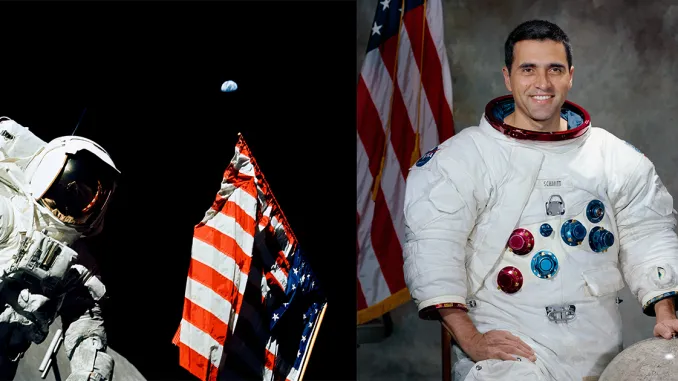
Harrison Hagan “Jack” Schmitt, born on July 3, 1935, in Santa Rita, New Mexico, is a distinguished American geologist, former NASA astronaut, and former U.S. senator from New Mexico. He grew up in Silver City, where he developed an early interest in science and exploration. His introduction to the outdoors came through his involvement in the Boy Scouts, where he participated in overnight trips with his pack and troop. These experiences were pivotal in developing his social skills and fostering a deep appreciation for outdoor life, complementing the lessons he learned from his parents. Although he finished his Scouting experience as a Second Class Scout, the skills and confidence he gained laid a foundation for his future achievements.
Schmitt pursued higher education at the California Institute of Technology, earning a Bachelor of Science degree in geology, and then studied at the University of Oslo in Norway as a Fulbright Scholar before obtaining a Ph.D. in geology from Harvard University. His professional journey led him to the U.S. Geological Survey’s Astrogeology Center in Flagstaff, Arizona, where he developed geological field techniques for the Apollo missions. His expertise in lunar geology was instrumental in training astronauts and preparing them for space exploration.
In June 1965, Schmitt was selected as part of NASA’s first group of scientist-astronauts. He became the Lunar Module Pilot for Apollo 17, the final manned mission to the Moon, in December 1972. During this mission, he became the first and only professional scientist to walk on the lunar surface, collecting samples and conducting experiments that have provided invaluable insights into lunar geology.
Following his retirement from NASA in 1975, Schmitt served as a U.S. senator from New Mexico from 1977 to 1983, focusing on science, technology, and space policy. After his tenure in the Senate, he continued contributing to science and public policy through consulting and advisory roles, advocating for lunar exploration and resource utilization. He has emphasized the Moon’s potential as a source of energy and materials for future space endeavors.
Schmitt’s legacy extends beyond his scientific achievements and political service. He remains active in promoting space exploration and education, participating in public speaking engagements and educational initiatives. His early experiences in Scouting continue to influence his perspective on exploration and the importance of fostering curiosity and resilience in young people. As of 2025, Harrison Schmitt continues to be a prominent figure in science, space exploration, and public policy, inspiring future generations to explore and understand the world beyond our planet.