

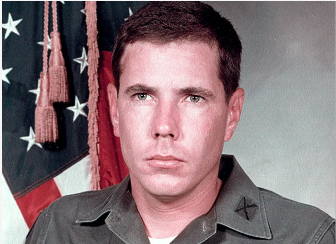
by Mike Matzinger
Hugh Clowers Thompson Jr. (1943 – 2006) grew up in Stone Mountain, Georgia and was a Boy Scout. Both his father and brother served in the military. Thompson joined the Navy after high school and served three years in a Seabee construction unit before working as a funeral director. He later enlisted in the Army in 1966, became a helicopter pilot, and deployed to Vietnam in 1967 with the 161st Aviation Company.
On March 16, 1968, Thompson and his crew, Glenn Andreotta and Lawrence Colburn, were on a reconnaissance flight when they saw American troops firing on unarmed civilians in the village of My Lai. Thompson was shocked by what he witnessed and decided to intervene. He landed his small helicopter between advancing soldiers and frightened villagers, confronted the soldiers, and escorted a group of civilians to safety with help from nearby Huey pilots. Despite their efforts, many hundreds of villagers had already been killed. Thompson repeatedly reported the killings to command staff, and his actions helped bring about a cease fire order that stopped further attacks.
Although he was initially given a citation that misrepresented events, he discarded it in protest. He continued flying missions until his helicopter was shot down, leaving him with serious injuries that required evacuation to Japan. He returned to the United States later in 1968 and spent the following years serving as a flight instructor and holding assignments at Fort Rucker, Fort Jackson, South Korea, Fort Ord, Fort Hood, and Hawaii. Thompson retired from the Army in 1983.
For years he faced criticism, hostility, and accusations of disloyalty for testifying about what happened at My Lai. In later life he worked as a helicopter pilot in the Gulf of Mexico, then as a counselor for the Louisiana Department of Veterans Affairs. Over time public understanding of his actions shifted. In 1998, thirty years after My Lai, Thompson, Andreotta, and Colburn received the Soldier’s Medal for their courage in protecting civilians. Military leaders described their actions as a lasting example of moral conduct in war. Residents of My Lai preserve his name and memory in a local museum.
Thompson also appeared in documentaries and interviews, including the film Four Hours in My Lai, which received major awards. He spoke widely about ethics in combat and was honored by several academic institutions, including Connecticut College and Emory University. In 1999 he received the Peace Abbey Courage of Conscience Award for helping save Vietnamese civilians. Thompson died in 2006, and his legacy remains central to discussions of moral leadership and responsibility during wartime.
“The mission of Scouting America is to prepare young people to make ethical and moral choices over their lifetimes by instilling in them the values of the Scout Oath and Law.”
America250: Army Veteran Hugh Thompson Jr.