

by Mike Matzinger
For Eagle Scout Drew Neill, it all began with an article he read in the eighth grade titled “Authentic Down to Their Underwear.” The article described Civil War reenactors who wore the same clothes, ate the same food, and listened to the same music that had been popular more than a hundred years earlier. The idea of reenacting, or “living history,” fascinated him, and he eventually dedicated both his personal and professional life to it.
Drew has spent his career in the museum field, serving as a historical interpreter at Old Salem and currently at Alamance Battleground State Historic Site. As a hobby, he has portrayed a Revolutionary War soldier, and professionally he has worked as a colonial tailor and shoemaker. His current passion project is researching and portraying a pre-1950s era Scoutmaster.
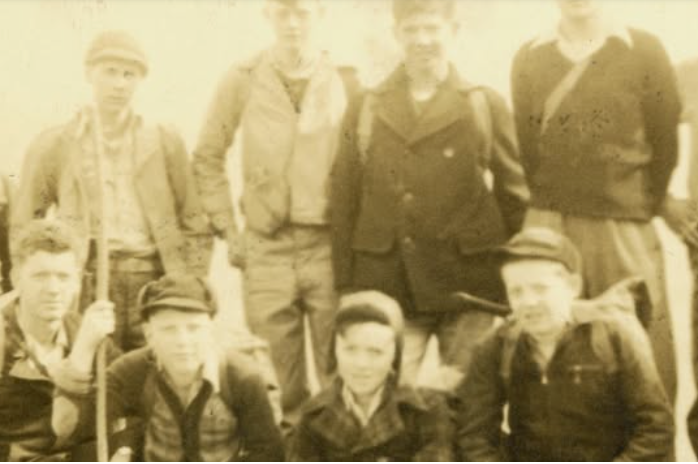
An assistant Scoutmaster in Burlington, North Carolina, Drew decided a few years ago to recreate a more modern time period. He thought it would be fun to portray a Scoutmaster from the Greatest Generation. It was a natural fit. For Drew, Scouting is more than a program. It is a living, breathing connection to our past.
Thanks to old manuals, including his grandfather’s prewar Scoutmaster’s Handbook, back issues of Boys’ Life and Scouting magazine, and research conducted by Scouting collector Mitch Reis, Drew has created an accurate depiction of Scouting during World War II.
Drew enjoys attending Scouting functions and World War II reenactments to discuss the impact Scouting has had on American society. Scouts especially enjoy hearing stories about how Scouts contributed to the war effort through scrap metal drives, victory gardens, paper collections, and gathering milkweed for life jackets. They are also fascinated by the old advancement requirements and enjoy comparing them to those of today.
To help illustrate the material culture of wartime Scouting, Drew wears an original uniform and has collected several wartime Scout awards and pieces of equipment, including a prewar sleeping bag. He encourages youth to embrace the do-it-yourself spirit of early Scouting by demonstrating homemade equipment built from Boys’ Life articles and then sharing the original instructions so they can build the items themselves.
Drew says his favorite part of the project is the “experimental archaeology” involved in recreating items from Boys’ Life or Scout manuals and then putting them to use. This allows him to see how well they work and better understand what Scouts experienced a few generations ago. One of his favorite experiences has been sleeping under a homemade “Simple Shelter” designed by Green Bar Bill, wrapped in a wool blanket, and cooking recipes from Horace Kephart.
Scouting is an unbroken chain, and every Scout and Scouter is a link in that chain. Drew hopes to instill in Scouts an appreciation for the traditions, adventures, and service that have made Scouting meaningful for more than a century. Scouting’s history is not just something to remember, but something that continues to inspire us today.
Learn more about the WWII Scoutmaster Project on Facebook: